Beyond Text: Navigating the 3 Critical Hurdles of Multimodal AI Agent Deployment
Introduction
Multimodal AI agents are AI systems that can process images, documents, and audio alongside text. Instead of typing "what are the calories in this meal?", a user can simply take a photo and get an answer. These systems unlock use cases that were impossible for text-only chatbots, from visual product search to document parsing to real-time safety inspection.
On paper, it sounds simple: upload a photo, ask a question, get an intelligent response. Many startups and health apps are building exactly this kind of system today. In practice, deployment is where things get hard.
The challenges are not about model selection or prompt writing. They show up in system design, in the form of three unavoidable problems that every multimodal deployment team eventually hits: token cost, latency, and accuracy. Understanding these trade-offs before you build is the difference between a product that scales and one that works only in demos.
Problem Statement
Most early-stage multimodal prototypes work well in controlled settings. A developer uploads a clean, well-lit food photo and the model returns a reasonable description. This gives the impression that multimodal AI is ready to ship.
Then real users arrive. They send dark, blurry restaurant photos taken at an angle. They upload raw camera images that are ten megabytes each. They expect sub-two-second responses while standing in line. They make health decisions based on the calorie estimates the system returns.
The demo worked because the conditions were ideal. Production fails because users are unpredictable, networks are slow, and the cost model was never validated at scale. The three hurdles below are where the gap between prototype and production lives.
Core Concepts and Terminology
| Term | What It Means in Multimodal Context |
|---|---|
| Visual Tokens | The numerical representations generated when an image is processed by a vision encoder. These consume context window space and API budget just like text tokens. |
| Vision Encoder | The component of a vision-language model that converts an image into embeddings the LLM can process. Processing time here is a primary source of latency. |
| VLM (Vision-Language Model) | A model capable of processing both images and text simultaneously. Examples include GPT-4o, Claude, and LLaVA. |
| Grounding | The degree to which the model's output is anchored in what is actually visible in the image rather than inferred from training data patterns. |
| Hallucination | When the model describes or assumes details that are not actually present in the image. |
| One-Shot Prompting | Asking the model to complete multiple sub-tasks in a single prompt, rather than chaining separate calls for each step, a key latency reduction strategy. |
| Multimodal Agent | An AI system that combines image understanding, language reasoning, tool use, and memory into a coordinated pipeline capable of multi-step problem solving. |
How It Works, The Anatomy of a Multimodal Agent
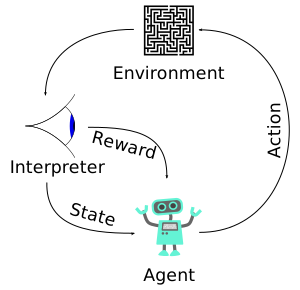
Understanding the mechanics of a multimodal agent reveals exactly where cost, latency, and accuracy problems originate. The following steps describe how a request flows through a production-grade multimodal system, using a food photo submission as the example.
- Image intake and preprocessing. The user's device captures a photo and the application resizes and compresses it before transmission. This step happens before the image reaches any AI model. Skipping it causes unnecessary token cost and upload latency.
- Vision encoding. The image arrives at the model provider's infrastructure, where a vision encoder converts the pixel data into a sequence of visual tokens, numerical representations the language model can process. This encoding step is the dominant source of latency in multimodal systems and is irreducible regardless of the size of the text response.
- Specialised detection. A fast, domain-trained computer vision model scans the image for food items and returns a structured list. This step is faster and cheaper than asking a general VLM to describe the scene in natural language, and more accurate for the specific classification task.
- Database retrieval. For each detected food item, the system queries a verified nutrition database to retrieve calorie and macro values. The model does not generate these numbers; it looks them up. This is the single most important accuracy decision in a health-oriented system.
- LLM reasoning and response generation. The language model receives the structured detection output and the retrieved nutrition values, then produces a conversational response. At this stage the model handles uncertainty, estimating portion sizes by asking clarifying questions, reconciling ambiguous items, and generating the final user-facing explanation.
- Memory update. The meal log, daily totals, and any new user preferences are written to external structured storage. The next request will retrieve only the relevant subset of this history rather than loading everything into the context window.
- Output validation. An optional consistency check verifies that calorie values are within plausible ranges before the response is returned to the user. Outputs that fail validation trigger a clarifying question rather than an incorrect answer.
Practical Example: A Health Tech Startup's Build vs. Buy Decision
A health tech startup building a calorie tracking app faces a concrete version of the cost-latency-accuracy trade-off early in development. They have three realistic options for their core recognition component, and each represents a different position on the trade-off triangle.
Option one is a single general-purpose VLM for the entire pipeline. This is the easiest to prototype and the most flexible, but the most expensive per query, the slowest for the user, and the least accurate for regional cuisine. It also generates nutrition facts rather than retrieving them from a verified source, which creates hallucination risk in a context where the numbers affect health decisions.
Option two is a specialised food recognition API, the kind offered by established nutrition tracking platforms, combined with a lightweight LLM for natural language output. This is faster and cheaper than option one, with better accuracy for foods in the API's catalogue. The limitation is coverage: unusual or regional items that the API does not know are invisible to the system.
Option three is a custom pipeline: a fine-tuned classification model for detection, a verified nutrition database for facts, and a general LLM only for reasoning and conversation. This is the most work to build and maintain, but it provides the best accuracy at scale, the lowest per-query cost once deployed, and full control over every trade-off decision.
Most teams start with option one, hit the cost and latency wall at moderate scale, and migrate to option three. Building option three from the start requires more upfront investment but avoids a costly rearchitecting effort that is painful to execute under growth pressure.
Advantages of Multimodal AI Agents
- Eliminates manual data entry friction. Users can interact with physical objects, documents, and environments directly rather than typing descriptions, lowering the activation energy for consistent engagement.
- Enables physical-world use cases. Food logging, document parsing, quality inspection, and visual search are only possible with image understanding and cannot be replicated by text-only systems regardless of how capable those systems become.
- Creates naturally intuitive interfaces. Taking a photo is faster and more natural than searching a food database for most users, particularly those who are not comfortable with typed search queries.
- Combines modalities for stronger reasoning. A system that can read both a restaurant menu image and a user's dietary history can provide personalised, context-aware responses that neither modality could support alone.
- Supports richer, verifiable outputs. When combined with retrieval from verified databases, multimodal agents can produce answers grounded in authoritative sources rather than generated estimates.
Limitations and Trade-offs
- Cost per query is significantly higher than text-only systems. Image token costs, combined with multi-step pipelines, make multimodal agents expensive to run at scale. The gap widens as usage grows.
- Latency is a structural challenge. Vision encoding takes time that cannot be streamed away. Users notice waits above four to five seconds in consumer applications, and this threshold is particularly unforgiving in mobile use cases.
- Physical ambiguity cannot be resolved by the model. Portion estimation, depth judgements, and scale inference are limited by the information available in a two-dimensional photo. No model upgrade changes the underlying physics.
- Hallucination risk is higher than in text-only systems. The model can produce confident descriptions of things not actually in the image, particularly for ambiguous or low-quality photos. Health applications amplify the consequences of these errors.
- Domain accuracy requires domain-specific training. General VLMs perform poorly on specialised categories, regional foods, medical images, industrial defects, that are underrepresented in their training data.
- Memory management adds architectural complexity. Supporting long-running personalised interactions without unbounded context growth requires external storage, retrieval systems, and summarisation logic that a text chatbot does not need.
Common Mistakes
- Sending raw, unresized camera images to the model without preprocessing, causing unexpected cost spikes that only appear in real-world traffic.
- Chaining all model steps sequentially when some can safely run in parallel, multiplying total latency unnecessarily and making the app feel broken to users.
- Expecting model upgrades to fix portion estimation, which is a physical grounding problem rather than an intelligence problem. A larger model that still sees a 2D image without depth information cannot estimate grams more reliably.
- Generating nutrition facts with the LLM instead of retrieving them from a verified database, creating hallucination risk in a context where users make health decisions based on the numbers.
- Storing full conversation histories in the context window rather than using external structured memory, causing per-request costs and latency to grow linearly with user engagement over time.
- Testing only with ideal, well-lit, single-food images rather than the blurry, multi-dish, angled photos real users take. The gap between controlled testing and real-world conditions is where most multimodal deployments encounter their worst surprises.
Best Practices
- Preprocess images on the client device before upload, resize, compress, strip metadata, to cut upload time and token cost simultaneously rather than treating these as separate problems.
- Use specialised detection models for visual recognition and reserve the general LLM only for reasoning and natural language output. The LLM explains; the detection model classifies; the database provides the numbers.
- Build a clarifying question loop for uncertain cases rather than guessing. User confirmation is always more reliable than model estimation of physical quantities such as portion size and depth.
- Store user history externally in structured SQL and use vector retrieval to surface only the most relevant context per request, keeping context windows manageable regardless of how long the user has been engaged.
- Retrieve facts from verified databases rather than generating them free-form. This is the single most important reliability decision in any health, legal, or financial multimodal application.
- Monitor cost and latency per request from day one. The first month of real traffic will reveal whether your architecture is financially and technically sustainable at your target user volume.
- Test with realistic user inputs: blurry images, unusual angles, unfamiliar foods, and multi-dish plates. A system that only works with demo-quality photos is not a production-ready system.
Comparison: Multimodal Agent Architectures
| Architecture | Cost Per Query | Latency | Accuracy | Best For |
|---|---|---|---|---|
| Single General VLM | High | High | Moderate | Prototyping and flexible use cases where scale is not yet a concern |
| Specialised API + Lightweight LLM | Medium | Medium | High (for known items) | Early production with a well-defined food category and an established API provider |
| Custom Pipeline (fine-tuned CV + DB retrieval + LLM) | Low at scale | Low | Highest | Production systems with high accuracy requirements, regional cuisine, or large user bases |
| All-in-One VLM with RAG | Medium-High | High | High | Applications requiring flexible scene understanding combined with grounded fact retrieval |
FAQ
Will a larger, more capable VLM fix the accuracy problems?
For some problems, recognising unusual foods or understanding complex scenes, a larger model helps. But for portion estimation from a single photo, the limiting factor is physical information, not model capability. A larger model that still sees a 2D image without depth data cannot determine exact grams any more reliably than a smaller one. Invest in clarifying question loops and user confirmation for physical quantities rather than in a more expensive model.
How do I handle regional or uncommon foods that the model does not recognise?
General VLMs perform poorly on foods underrepresented in their training data, particularly regional cuisines from Southeast Asia, the Middle East, and Africa. The most reliable approach is to fine-tune a specialised classification model on your target cuisine categories, or to use a retrieval system where users confirm from a curated database of locally relevant foods. Relying on a general VLM for regional coverage without fine-tuning leads to inconsistent results that erode user trust.
What is the minimum image resolution needed for reliable food recognition?
For most food classification tasks, images at 512px on the longest edge are sufficient for the model to identify major food items. Going below this threshold introduces ambiguity for mixed dishes; going above it increases token cost without proportional accuracy gains. The exception is text reading within images, labels, menus, nutrition panels, where higher resolution is necessary. For those cases, use a dedicated OCR engine rather than passing the image to the VLM at high resolution.
Is streaming enough to address multimodal latency?
Streaming helps with text chatbot latency by beginning output before generation is complete. In multimodal systems, it helps less. The model must finish processing the image before it can generate meaningful tokens, so users still experience a blank-screen wait at the start of each response even with streaming enabled. Streaming addresses output latency; vision encoding latency is irreducible and must be addressed through architecture, not streaming.
Is it worth building a multimodal agent or should I use an existing nutrition API?
For most early-stage products, an existing nutrition API combined with a lightweight LLM for conversation is the right starting point. Build a custom multimodal pipeline only when you have demonstrated that existing APIs cannot meet your accuracy or coverage requirements, or when your target users include cuisine categories not well-served by general APIs. The custom pipeline is the right destination for most serious products, but it should be earned through demonstrated need rather than assumed from the start.
References
- Liu, H., et al. (2023). Visual Instruction Tuning (LLaVA). NeurIPS 2023.
- Yao, S., et al. (2022). ReAct: Synergizing Reasoning and Acting in Language Models. arXiv:2210.03629.
- Radford, A., et al. (2021). Learning Transferable Visual Models From Natural Language Supervision. ICML 2021.
- OpenAI (2023). GPT-4V System Card. openai.com
- Wu, Q., et al. (2023). AutoGen: Enabling Next-Gen LLM Applications via Multi-Agent Conversation Framework. arXiv:2308.08155.
Key Takeaways
- Images are not free, they consume a disproportionately large share of your token budget, and costs grow non-linearly with resolution and multi-step pipeline depth.
- Specialised CV models for detection combined with LLMs only for reasoning reduce both cost and latency compared to routing every step through a single general-purpose VLM.
- Portion estimation from a single photo is a grounding problem, not a model intelligence problem. Physical ambiguity cannot be resolved by switching to a larger or more expensive model.
- External structured memory, SQL for tallies and history, vector retrieval for relevant context, keeps context windows manageable as users accumulate long engagement histories.
- Multimodal deployment is fundamentally a product trade-off problem. There is no configuration where you achieve maximum accuracy, zero latency, and minimal cost simultaneously. Every deployment is a set of deliberate choices.
- Test with realistic user inputs, not ideal sample images. The gap between controlled testing and real-world conditions is where most multimodal deployments encounter their worst production failures.